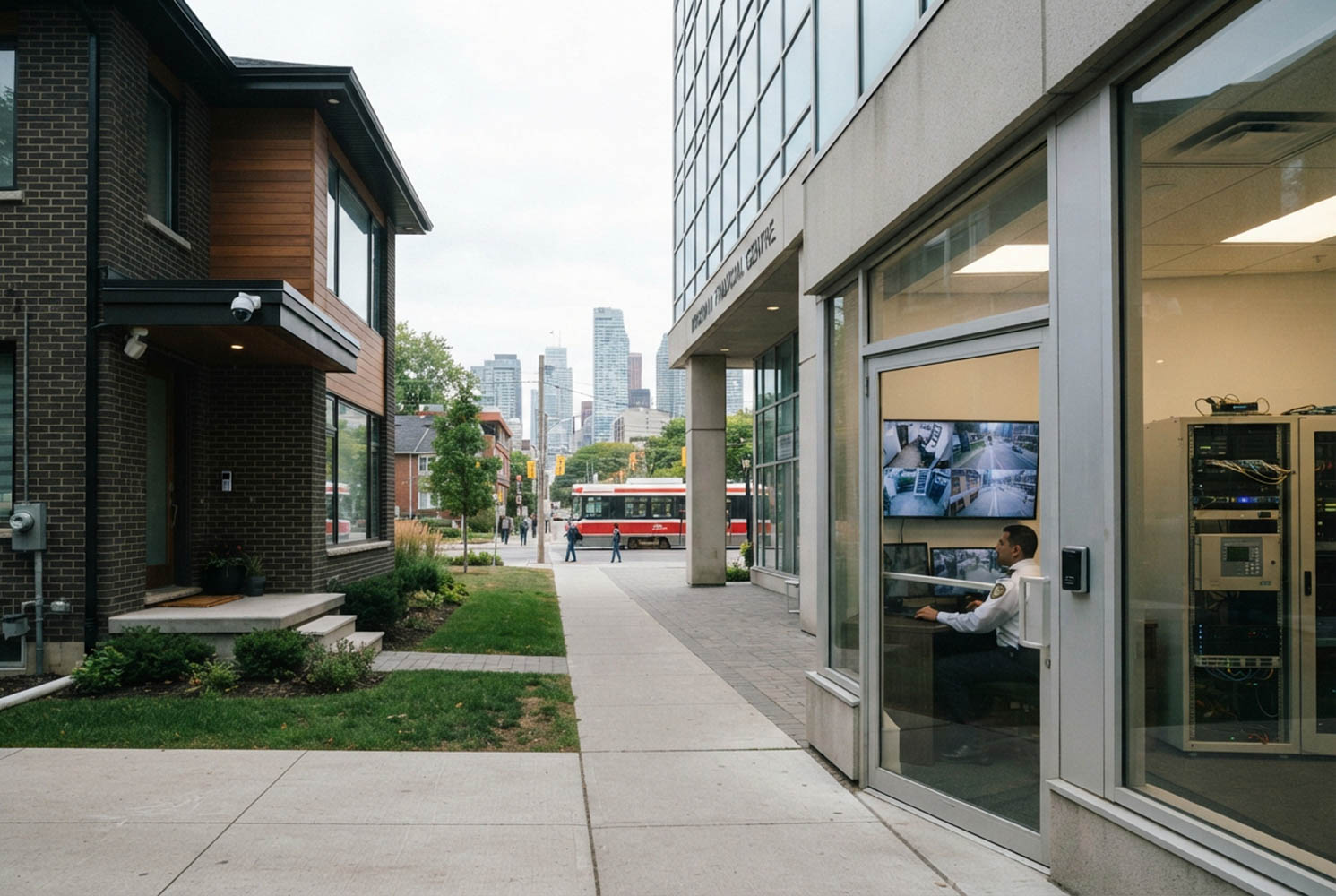
Choosing between home vs. commercial security systems starts with understanding that a house and a business have very different security requirements. When we assess a property, we look at how people enter and move through the space, what needs to be protected, how the property is used throughout the day, and what should happen if an alarm or security event occurs. For homeowners and business owners alike, the goal is not simply to install more equipment—it is to build a system where each component has a purpose.
Home Security: Protecting People, Property and Everyday Life
A residential security setup is usually designed around the household’s routines. A typical system may include a control panel or keypad, door and window sensors, motion detectors, cameras, lights and audible sound devices.
The alarm panel acts as the central point of the system. Sensors detect activity at protected doors, windows or other areas, while cameras provide visual information. Depending on the setup, these components can work independently or communicate with one another.
For example, a door sensor may trigger the alarm when a protected entrance is opened while the system is armed. A camera can provide a visual view of what is happening, while lighting can improve visibility around an exterior entrance. Together, these technologies provide more information than any single device could provide on its own.
This is where professionally designed home security systems Toronto homeowners rely on can differ from an off-the-shelf setup. The right combination depends on the property’s layout, entrances, detached garages, basement access, outdoor areas and the family’s day-to-day habits.
Commercial Security Has a Different Set of Priorities
A business typically has more people, more access points and more areas that may need different levels of protection. A retail store, office, warehouse, medical facility or industrial workspace may also need security controls that change depending on business hours or employee responsibilities.
Commercial alarm systems can incorporate intrusion detection alongside digital video surveillance. Cameras can help monitor entrances, parking areas, receiving zones, offices and other sensitive locations, while the alarm system provides another layer of detection.
Access is another major difference. With commercial access control, a business can use card readers, access panels or centralized control systems to manage who can enter specific areas. Instead of relying entirely on traditional keys, access credentials can be assigned according to employees, departments or restricted spaces.
Consider an office where employees need access to the main workspace, but only certain staff members should enter a server room. An access control system can establish those permissions, while cameras can provide an additional visual record of activity. The alarm system adds another layer if an unauthorized entry occurs.
The systems become particularly useful when they work together rather than operating as isolated products.
How Security Components Work Together
Think of a security system as several layers rather than one product.
- Alarms detect specific events, such as an unauthorized door or window opening.
- Cameras provide visual awareness and help confirm what is happening.
- Access control manages who can enter and which areas they can access.
- Keypads and control panels give authorized users a central way to arm, disarm or manage the system.
- Lighting and sound devices can support detection and make certain areas more visible or noticeable.
- Video entry systems can help residents or staff identify visitors before granting access.
For multi-unit residential properties, multi-tenant video entry can extend that approach by allowing residents or building staff to identify visitors before providing access. In a business environment, the same principle can be applied differently, with access credentials and surveillance helping manage employees, contractors and visitors.
For specialized environments, security requirements can go beyond conventional intrusion protection. Hospitals, medical centres, transit facilities, colleges and universities may require emergency-focused solutions, while tools such as thermal imaging, temperature measurement systems or security screening equipment may be appropriate in specific operational settings.
The important point is that these technologies should be selected according to the environment—not simply added because they are available.
Key Differences Between Residential and Commercial Systems
The biggest difference is usually scale and complexity, rather than the basic technology itself.
A homeowner may primarily want to know that their family and property are protected when everyone is asleep, away at work or travelling. A business owner may also need to control employee access, protect inventory or equipment, monitor multiple areas, secure a physical workplace and maintain visibility across a larger property.
Here are some common distinctions:
| Residential Security | Commercial Security |
| Focuses primarily on family and property | Protects people, premises, assets and operations |
| Fewer entrances and users | Multiple entrances, users and access levels |
| Often centred around an alarm, cameras and sensors | May combine alarms, surveillance and access control |
| Simple daily operation is important | Permissions, schedules and multiple zones may be important |
| Usually protects one residence | May need to protect offices, stores, warehouses or multiple locations |
That does not mean every home needs a simple system or every business needs a highly complex one. A large Toronto home with a detached garage and several exterior access points may require a more extensive installation than a small office.
Likewise, a small business may only need a carefully planned alarm, cameras and controlled entry rather than an oversized system.
What We Recommend for Homeowners
For most homeowners, we recommend thinking in layers.
Start with the property’s most important entry points. From there, consider which areas would benefit from motion detection, cameras, exterior lighting or additional sensors. If the property has a garage, side entrance, basement entrance or less-visible rear area, those locations should be considered as part of the overall design.
A practical residential setup may combine:
- Door and window sensors for primary entry points
- A central keypad or control panel
- Interior or exterior cameras where visibility matters
- Motion detection in selected areas
- Audible notification or sound devices
- Exterior lighting around vulnerable approaches
- Professional monitoring where appropriate
For homeowners considering security camera installation Toronto services, we recommend looking beyond the number of cameras. Placement is often more important. A well-positioned camera covering a meaningful approach or entrance can be more useful than several cameras aimed at overlapping areas.
Most importantly, don’t purchase individual devices first and try to make them work together afterward. Begin with the property and its risks, then build the system around those requirements.
What We Recommend for Business Owners
For business owners, we recommend starting with the way your workplace actually operates rather than choosing security equipment based on the size of the property alone. Think about who needs access, which areas contain valuable equipment or sensitive information, when the premises are occupied, and what should happen if an unauthorized entry occurs.
A well-planned commercial setup may combine:
- Commercial alarm systems to detect unauthorized entry and activity after hours
- Digital video surveillance for visibility around entrances, workspaces, parking areas and other important locations
- Card readers and access panels to control who can enter specific parts of the building
- Keypads and user credentials for authorized staff and designated access points
- Video entry systems for offices or multi-tenant properties where visitors need to be identified before access is granted
- Emergency security solutions for specialized environments such as medical facilities, educational institutions and transit-related workplaces
For example, an office may use cameras to monitor the reception area and exterior entrances while card readers restrict access to employee-only spaces. A warehouse might place greater emphasis on perimeter detection, loading areas and after-hours surveillance. A medical facility may have additional requirements around controlled access and emergency response.
This is why commercial security systems Toronto businesses use should be designed around the workflow of the organization. The objective isn’t simply to put cameras on walls or alarms on doors. Each component should support the others and address a specific security requirement.
Business owners should also consider future changes. If your company expects to add employees, expand into another part of the building or change how different departments access the workplace, a scalable system can make those changes easier to accommodate.
The best approach is therefore a customized one: assess the property, identify the most important risks and operational requirements, and then select the combination of alarms, surveillance, access control and other technologies that provides appropriate coverage without adding unnecessary complexity.
Get a Security Solution Built for Your Property
Security works best when the equipment, installation and layout are considered together. A local security provider can assess your home or workplace, identify practical vulnerabilities and recommend a customized combination of alarms, cameras, access control and other technologies.
Whether you are upgrading an existing system or starting from scratch, we can design and install comprehensive security solutions for homes, businesses and physical workspaces throughout Toronto and the GTA.
Call us to request a quote or schedule a consultation. Our team can help you determine which home vs. commercial security systems best suit your property, security needs and day-to-day requirements.