In a busy city like Toronto, subway station security plays an important role in protecting passengers, employees, infrastructure, and the surrounding community, particularly when an emergency requires a fast, coordinated response.
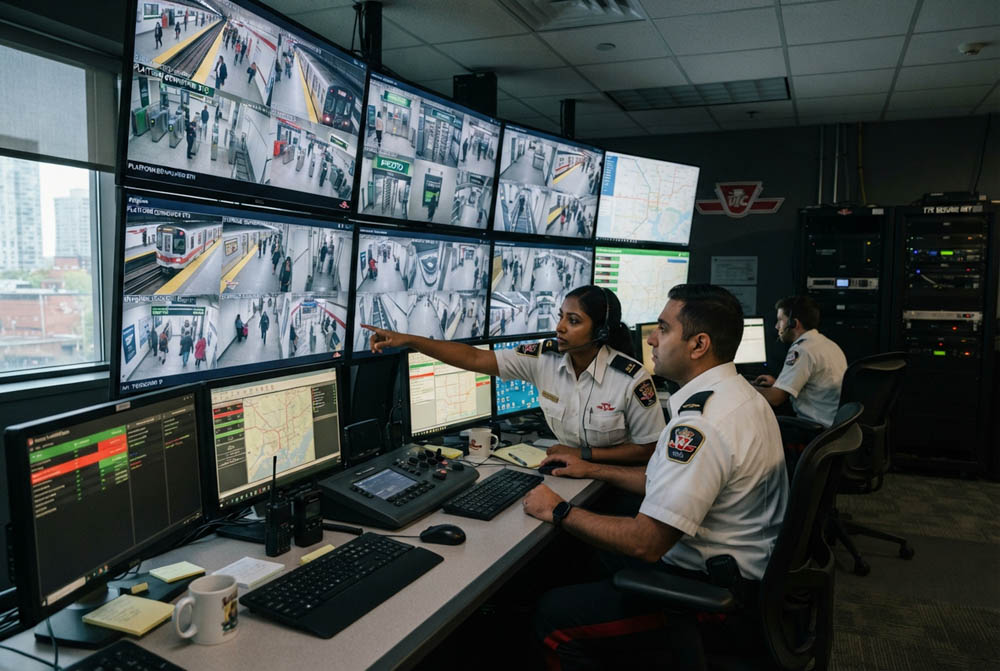
Toronto’s subway stations are complex environments. Thousands of people can move through entrances, platforms, corridors, stairwells, elevators, and other shared areas throughout the day. With so many people and activities taking place in one location, security cannot rely on a single camera or alarm. A well-designed approach combines monitoring, detection, controlled access, communication, and rapid response.
For businesses, transit facilities, property managers, and organizations operating near major transportation hubs, understanding how these technologies work together can provide valuable insight into creating safer physical environments.
Why Emergency Monitoring Matters in Transit Facilities
An emergency in a subway station can develop quickly. A medical incident, unauthorized access, suspicious activity, fire, security threat, or other unexpected event can require staff to identify the situation and respond without unnecessary delay.
This is where emergency monitoring systems can make a meaningful difference. Instead of relying entirely on someone noticing a problem and reporting it, integrated technologies can provide security personnel with information about what is happening across different areas of a facility.
Effective monitoring can help teams:
- Detect unusual or potentially dangerous activity.
- Identify incidents in areas that may not always be visible to staff.
- Verify alarms or alerts through video and other connected devices.
- Restrict access to sensitive or staff-only areas.
- Provide useful information to personnel responding to an incident.
- Create a record that can assist with incident reviews and investigations.
The objective is not simply to watch a property. It is to give the people responsible for safety better information when every second matters.
Building a Layered Transit Security System
No single technology can address every security concern in a large transportation facility. The strongest approach is typically layered, with different systems supporting one another.
For example, security camera systems can provide visibility across entrances, platforms, corridors, parking areas, and other important locations. Video surveillance can help personnel assess an event while also providing recorded footage when an incident needs to be reviewed afterward.
Access technology provides another layer. Access control systems can help regulate entry to restricted areas such as maintenance rooms, electrical spaces, offices, equipment rooms, or other locations that should not be accessible to the general public.
Depending on the facility, an integrated security plan may also include:
- Card readers and controlled entry points.
- Digital video surveillance.
- Intrusion detection devices.
- Emergency communication equipment.
- Audible or visual warning devices.
- Centralized monitoring and alarm management.
- Additional screening or detection technologies where appropriate.
The advantage of an integrated approach is that these technologies can complement one another rather than operate as isolated pieces of equipment.
How Technology Can Support Faster Emergency Response
When an alarm occurs, knowing that an incident has happened is only the beginning. Personnel also need enough information to understand what is happening and determine the appropriate next step.
Consider a hypothetical situation in which an unauthorized person enters a restricted service area. An access control event could identify the attempted entry, while nearby cameras could help personnel verify the situation. If additional emergency equipment is integrated into the facility’s security design, the response team can have more information available from the outset.
The same principle applies across a range of environments. Emergency solutions can be particularly valuable in:
- Hospitals and medical centres, where personnel may need to respond quickly while maintaining patient safety.
- Colleges and universities, where large populations and multiple buildings can make incident communication more complex.
- Transit depots and transportation facilities, where staff may need to coordinate responses across larger or more active areas.
- Other high-occupancy facilities, where a single incident may require communication and assistance for many people at once.
In certain applications, specialized technologies can add another layer of situational awareness. Depending on the facility and its operational requirements, this may include:
- Thermal imaging equipment, which may assist personnel in challenging visibility conditions.
- Temperature-screening technologies, which may have specific applications in facilities where health screening forms part of the operational requirements.
- Integrated security technologies, which can bring information from different systems together to help personnel assess an incident.
The appropriate technology depends on the environment, risk profile, operational procedures, and privacy considerations. More equipment does not automatically mean better security. The goal is to select technologies that support the facility’s actual response needs and can be incorporated effectively into its overall security strategy.
Supporting Safety Beyond the Subway Station
Effective monitoring can extend beyond the transit facility itself. Subway stations connect residential buildings, offices, retail properties, schools, and other public spaces across Toronto, creating overlapping security considerations.
For example:
- Commercial properties may use video surveillance around entrances and exterior areas.
- Residential buildings may use video entry systems to help identify visitors before granting access.
- Businesses may combine controlled entry with surveillance to protect people, equipment, and sensitive areas.
This reflects a broader principle: security should be designed around how people actually use a property.
The same applies to homes. Residential security systems can combine cameras, sensors, keypads, lighting, and sound devices to create multiple layers of protection. While the technology varies by property, the goal remains the same: detect potential problems, provide useful information, and support an appropriate response.
Why Customized Security Planning Matters
Every property has different vulnerabilities.
A subway station has high passenger volumes, multiple access points, underground areas, restricted operational spaces, and complex movement patterns. A commercial building may be more concerned with unauthorized entry, theft, employee safety, or protecting valuable equipment. A multi-tenant property may place greater emphasis on controlled visitor access and common-area monitoring.
For that reason, a one-size-fits-all security package is rarely the best solution.
A professional assessment can consider factors such as:
- The layout and size of the property.
- Public and restricted areas.
- Existing cameras and security infrastructure.
- Entry and exit points.
- Employee and visitor traffic.
- Areas requiring additional monitoring.
- Emergency procedures and response requirements.
- Opportunities to integrate existing technologies.
This approach helps ensure that security investments are focused where they can provide the greatest practical benefit.
Build a More Comprehensive Security Plan
Effective security requires more than cameras alone. We can design and install customized solutions that combine video surveillance, access control, emergency monitoring, and other technologies based on your facility’s needs.
Whether you’re securing a subway station, transit facility, workplace, or commercial property, call us at (416) 498-9597 to request a quote or schedule a consultation with our team to discuss your requirements.