When Toronto homeowners ask us what a home security system should include, our answer is simple: it should be designed around the property, the people living there, and the risks that matter most—not assembled from a one-size-fits-all package. A reliable security setup brings several technologies together so your home is protected at the entry points, inside the property, and around its exterior.
For homeowners across Toronto and the GTA, that distinction matters. A detached home, condominium, townhouse, or multi-level property can have very different security requirements. Professional assessment and installation help ensure every component works together properly and provides practical protection when you need it.
1. A Professionally Designed Alarm System
At the heart of a comprehensive security setup is an alarm system that can detect unauthorized entry and immediately alert occupants or designated contacts.
A professionally configured system may include:
- A central control panel
- Keypads for convenient arming and disarming
- Wired or wireless door and window sensors
- Motion detectors
- Glass-break detection
- Audible sounders and alarms
- Security lighting
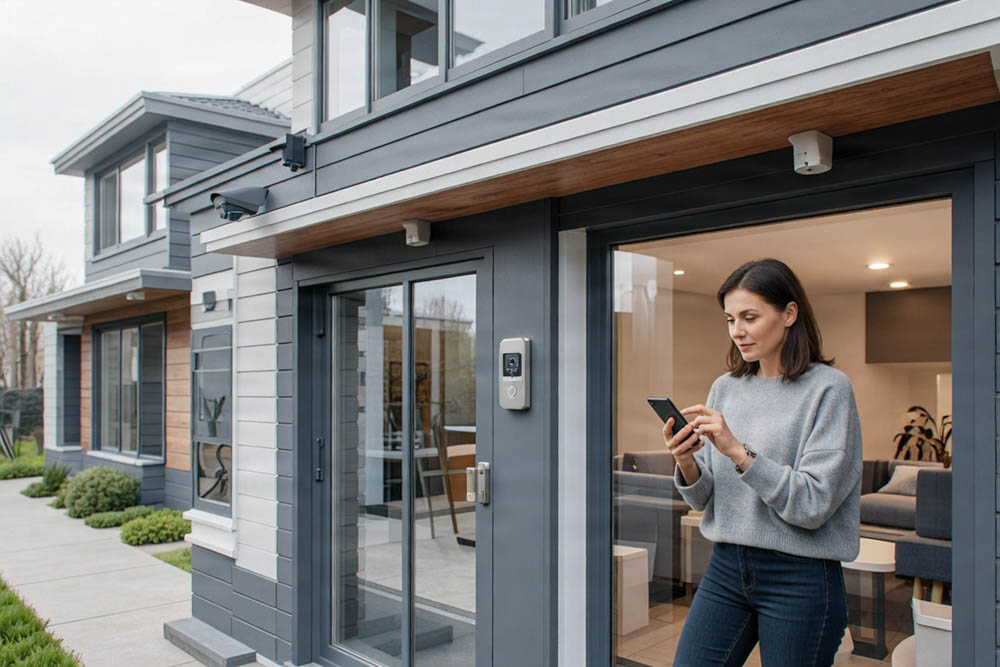
- Connected cameras and other smart devices
The right combination depends on your home’s layout and how your family uses the property. For example, a large Toronto home with several exterior doors may require more entry sensors and carefully positioned motion detection than a compact condominium.
This is one reason home security installation should not be treated as a simple DIY project. Sensor placement, communication between devices, coverage gaps, and system configuration all influence how effectively the equipment performs.
2. Security Cameras That Give You Visibility
An alarm can tell you that something has happened. Video surveillance can help you understand what is happening.
Strategically positioned cameras can provide visibility at:
- Front and rear entrances
- Driveways and garages
- Side entrances
- Backyards and other vulnerable exterior areas
- Interior locations where additional monitoring is appropriate
Modern security cameras for home applications can be integrated with other security equipment, allowing homeowners to monitor activity and receive alerts when something unusual occurs.
For a Toronto homeowner, cameras can be particularly useful for monitoring deliveries, checking activity around a garage, or seeing who is approaching the front entrance. But more cameras do not automatically mean better protection. Poor positioning can leave important areas uncovered while creating unnecessary overlap.
A professional installer can evaluate sightlines, lighting conditions, mounting locations, and privacy considerations before recommending equipment.
3. Access Control for Doors and Entrances
Your front door isn’t necessarily the only access point that deserves attention.
Basement entrances, garages, side doors, and secondary entrances can all become weak points if they aren’t properly secured. Depending on the property, access can be managed through keypads, electronic locks, credentials, or integrated control systems.
For larger residences, multi-tenant properties, or buildings with shared entrances, professionally designed access control can provide another layer of protection.
For example, a multi-unit Toronto property may benefit from a video entry solution that allows residents to identify visitors before granting access. This combines communication and controlled entry rather than relying solely on a traditional buzzer.
4. Smart Integration Without Making Things Complicated
A good security setup shouldn’t make everyday life harder.
Today’s smart home security solutions can bring alarms, cameras, lighting, sensors, and other devices together through a central platform. The goal isn’t to add technology simply because it exists. The goal is to make the property easier to monitor and manage.
Imagine arriving home after dark. Exterior lighting can improve visibility while cameras monitor the approach and your alarm system remains ready to respond if an unauthorized entry is detected.
Integration can also make it easier to identify unusual activity. A door sensor, camera, and lighting device working together can provide considerably more useful information than three disconnected products.
5. Professional Installation Is Part of the Protection
One of the biggest mistakes homeowners can make is assuming that purchasing quality equipment is enough.
It isn’t.
Even excellent technology can underperform when sensors are installed in unsuitable locations, cameras have obstructed views, wireless devices communicate poorly, or the system isn’t configured correctly.
A professional assessment should consider:
- The property’s construction and floor plan
- Entry and exit points
- Existing security equipment
- Wi-Fi and communication requirements
- Camera positioning and lighting
- Household routines
- Potential vulnerabilities
- Future expansion needs
Professional installation also gives homeowners an opportunity to understand how the system operates. Knowing how to arm and disarm the alarm, manage access, review camera footage, and respond to alerts is just as important as having the equipment installed.
6. Choosing the Right Security Partner
The company behind your installation matters just as much as the equipment.
Before selecting a provider, Toronto homeowners should ask:
- Will you assess my property before recommending equipment?
- Can you integrate alarms, cameras, access control, and other devices?
- Who will install and configure the system?
- Can the system be expanded as my needs change?
- What support is available after installation?
These questions can reveal whether you’re dealing with a company focused on selling individual products or a professional security partner focused on creating a complete solution.
The latter approach is especially valuable when your needs extend beyond a basic alarm. A provider with experience across residential and commercial environments can often identify integration opportunities that aren’t obvious from a product catalogue.
Security Should Be Designed Around Your Property
There is no universal checklist that works perfectly for every Toronto home. A downtown condominium may need a different combination of video entry, access control, and alarm technology than a detached home in North York or Scarborough.
The most effective approach starts with understanding the property and identifying its vulnerabilities. From there, a professional can recommend the appropriate combination of detection, surveillance, access control, lighting, and alarm devices.
We take the same approach with businesses, where security requirements may involve digital video surveillance, card-reader access panels, and centralized control systems. Specialized environments can require even more advanced solutions, but the principle remains the same: technology should be selected according to the application.
Overall, a complete security solution is more than an alarm or a collection of cameras. It is a coordinated combination of detection, surveillance, access management, smart technology, and professional expertise, designed around how your property actually operates. For Toronto homeowners, working with an experienced local provider can make the difference between simply owning security equipment and having a properly designed, professionally installed home security system that provides meaningful protection.
Secure Your Home With Confidence
Don’t leave your home’s security to guesswork. Contact our Toronto security experts today to schedule a professional assessment and get a customized recommendation for your property.
Call us at (416) 498-9597 or request a consultation to get started.